Monday, February 28, 2011

Crochet yourself a dog (or a dog toy)

Want a Lab, but without the chewing, barking, eating, pooping, playing, etc. that makes up life with a real dog?
Then crochet yourself one instead!
Just kidding. Who'd actually want to give up all that real world dogginess in exchange for a stuffed, lifeless version? Not me.
But I'll probably crochet myself a lab anyway.
The cutest book arrived in the mail earlier this year. It's call Ami Ami Dogs: Seriously Cute Crochet. It's named appropriately. These little stuffed dogs are as cute as they come.
First, I have to say I'm amazed I received this book. There is no chance in the world that the PR person responsible for finding places to mail the book to knew I'd spent my time off around the holidays learning to crochet.
What great timing.
Anyhow, I'm still learning the great art of crochet. So far, I have two scarves under my belt — one that was really more of a practice scarf, and one that I proudly wear around my neck every day now. Even the wearable scarf is far from perfect, though. I've got a lot of learning to do.
If you're like me, though — a dog lover who knows how to crochet — you have got to get this book. There are step-by-step instructions on how to make 12 different breeds of dogs. The breeds included are: Chihuahua, Welsh Corgi, Shiba, Cavalier King Charles Spaniel, Miniature Dachshund, Siberian Husky, Labrador Retriever, Maltese, Miniature Schnauzer, French Bulldog, Beagle and Pug.
They seem like pretty small little stuffed figures — each dog is between one and three inches long depending on the thickness of the yarn — which just enhances the adorable factor, if you ask me.
I was thinking about what I'd do with them once I finally get the nerve up to try a pattern. Dog toy? Nah. Too cute and too small for that. Key chain? Got enough of those. Knick-knack? I don't like clutter.
Christmas ornament! Cha-cheeng! I already have a small set of plush dog ornaments that I love. Now, I can crochet myself some more to join the pack.
And depending on how good I get at making these precious pooches, some friends and relatives may wind up with crocheted dogs as Christmas presents too.

Ami Ami Dogs: Seriously Cute Crochet
$14.99 paperback, on sale now
Check Amazon.com to view copies for sale

Tuesday, February 22, 2011

How to trim a dog's nails with manual clippers WITH VIDEO

Sensi getting his nails trimmed
All right folks, I've been promising this post for a long time and I'm finally delivering.
As for the delay, I'll ask you this: How often do you feel like getting in front of a camera on a weekend? Most of my weekends are spent cleaning or running errands, and I usually don't do any of those things in camera-worthy dress.
But alas, here's video of me trimming Sensi's nails.

Remember the story from a while back about a pit bull killed during a nail trim — suffocated and crushed by the groomer? (Outpouring of love for disabled girl whose service dog was killed) I remember a person's comment underneath one of those stories, basically saying that pit bulls are awful beasts and the groomer was probably doing everything in her power to get those nails trimmed — like it was necessary to choke the dog. And I believe the comment warned others about trying to trim a pit bull's nails.

Well, here's my pit bull getting his nails trimmed. As you can see, I hardly even have to give him a command. I show him the nail trimmers and the treats, he lays down and gets in position. He stays still while I do the work, waiting patiently for a treat. So, all you pit bull haters, watch and weep because I know you'll be wishing your dog was so well-behaved ...

Before you watch, here's a couple things to keep in mind:
1) Yes, Sensi's nails are waaaaay too long. It's been a lifelong battle. Now that I've shot this video, though, I've used the manual clippers for the last time. I'm going to start working back those nails daily with a Dremel (sanding tool). Wish me luck!
2) Want your dog to behave like this? Start with a down-stay. The down-stay is critical.


Here's some previous blog posts about nail trims:
Trimming Bubba's Nails WITH VIDEOS (Using a Dremel on an 8-year-old Boxer who had never before had his nails trimmed)
And, there's more on the way!

Wednesday, February 16, 2011

The food crisis is killing us — especially me!

Last year, when Sensi’s allergies became quite serious, I was outraged at the dog food companies.
I was convinced that the labeling of ingredients was sub-standard and downright evasive — what the heck good is it to me to know some mystery “animal byproduct” is in my dog’s food? That’s not an ingredient, it’s a way to legally hide ingredients.
I expressed my anger to my veterinarian and raised concerns that perhaps all this genetically modified crap — the corn that gets manipulated into tons of different ingredients and also fed to the cows and other livestock, to name just one genetically modified mess — is what’s causing allergies to be prevalent among dogs.
Calmly, he said something that’s haunted me every since:
“It’s not just the pet food industry, Karen,” he said. “We’re eating foods that have all the same sorts of issues, and it begs the question, how is it affecting our health?”
Fast forward six months: Brent and I befriend a couple who are very concerned about the state of food in America. We learn tidbits of terrifying things from them.
Fast forward another six months: Brent and I finally get Netflix. It’s changing our lives, I swear.
Last weekend, we watched the documentary Food, Inc. Last night, we watched the documentary Foodmatters.
Today, I feel totally in crisis.
Maybe I’ve been watching too many scare-you-straight documentaries, but in the past year, my concerns about food have grown from “Dog food companies need better regulation” to “Food is killing all of us, dogs, people, livestock — all of us — period.”
The most ironic thing is that the problems with our dogs seem to catch our attention more than the problems with ourselves. My cousin has experimented with an organic diet for her dog, even while she laments that it seems silly to buy expensive organic foods for her dog while she and her boyfriend can’t afford to buy organic foods for themselves.
And that’s where I’m at. I can’t afford to buy organic foods. I have a very tight grocery budget that relies heavily on corn-fed beef, starches and carbs that are full of ingredients that sound more like chemicals than food. There’s not a whole lot of choice in the matter for me. I suppose if I’m willing to skip five dinners, I could probably afford to bring home organic stuff for another five. But who can skip five dinners? Starving isn’t good for you either.
I am starting a garden this year and will be looking for heirloom plants — a.k.a., plants that aren’t genetically modified. Which, by the way, isn’t it ridiculous that there are so many genetically modified things out there that we have a specific category for those that are not? And we call them heirlooms, like they’re a thing of the past?
We’ve got it all wrong, folks. And our dogs are suffering right along with us.

Friday, February 11, 2011

New Weight Loss System from Hills — are we that dumb?

Obesity is most definitely a problem among American dogs.
It’s a problem that, in usual circumstances, is easy to prevent and easy to correct.

Want to know how? Here’s some advice:
  1. Feed your dog a decent brand of dry dog food. Don’t know how much to feed? Call your veterinarian and ask. Then, follow those guidelines. (So often I hear, ‘I was told to feed him this much, but it just didn’t seem like enough’). Excuse me, but are you a veterinarian? Didn’t think so. Since you’re not, listen to the professional. Simple stuff.
  2. Is your dog so picky he wouldn’t dare think about dry dog food? Try spicing it up by adding something healthy — warm up some kidney beans or green beans and mix ‘em in there. Try a little rice. Start heavy on the healthy adds, work your way down until the mix is more kibble, less adds.
  3. Stop feeding your dog people food and table scraps. Feeling guilty? Replace scraps with healthy treats. Cooked whole potatoes, green beans, mushy carrots ... It’s still human food; it’s just not junk. Can’t get past those “Precious Moments” beggin’ eyes? Train your dog not to beg. Train him to lay in his bed while you eat dinner. Train a “head down” command to combat begging while you snack. 
  4. Stop buying junkfood dog treats (Beggin’ Strips is my favorite example). There’s a whole market out there for healthy treats specifically for dogs. Buy those instead.
  5. Get your dog some exercise. Better yet, exercise with your dog.
The best thing to do is not feed your dog human food from the very get-go. Brent and I took this method. It’s wonderful. Sensi is old but fit. He doesn’t beg. He thinks healthy treats — raw carrots, frozen green beans, fresh celery, etc. — are the most wonderful things in the world. I’ve met dogs who have led human-food heavy lives who won’t even sniff a raw carrot. It’s such a shame.

My mom likes to guilt me about this. “Don’t you think he’s missing out?” she asks. “Don’t you feel bad that he has no variety in his diet?” She’s wrong. He has great, healthy, nutritional variety in his diet. He gets home-cooked adds — rice and beans along with some sort of meat — mixed into his food daily. He gets some of whatever veggies are in our fridge as treats. He gets warmed up oatmeal with peanut butter as a very, very special snack. I get creative with his diet and he loves it. And he’s healthy.

I just don’t understand. It’s not time consuming, it’s not rocket science. It’s simple stuff. So, why do we need a dog food company to prepackage meals and treats for us? Are we that dumb?

So much dog-related marketing and products just boils my blood. The new Hills Science Diet Weight Loss System leaves me dumbstruck. For a large dog, you can get a 4-week supply of diet food prepackaged into portioned meals along with prepackaged treats. It guarantees results in 30 days.

I’ll throw my support behind a product that helps dogs lose weight, but I think it’s the fact that there’s a market and a need for such a product that angers me. Are we really that dumb? I have no doubt there’s a mark-up in pricing for this special weight loss system — after all, healthy foods for people are more expensive than regular foods, why wouldn’t it be the same for dogs? So we’re willing to pay more to get less all because we’re too lazy and uninformed to manage our dog’s weight on our own? We really need a company to hold our hand on this one?

Here’s a newsflash: If you’re dog is overweight, it is more than likely due to the fact that you feed it far too much human food. Go ahead and buy this new weight loss system — I encourage everyone to take steps to bring down their dog’s weight — but it’s not going to stop your dog from begging. And if you just can’t help yourself from giving in to those beggin’ eyes, this new weight loss system isn’t going to solve your dog’s weight problem.

Wednesday, February 9, 2011

Adoptable 8-week-old Basset Hound puppy

Grace, 8 weeks old
All right, for those of you Dog Blog readers who double as newshounds, you may have noticed a story about the Rochester Cider Mill circulating among Southeast Michigan media outlets.
I'm proud to have started off that media frenzy by first reporting on this seemingly unbelievable story. If you haven't read it and are interested in finding out how growing corn and selling Christmas trees can make you a criminal, here it is: Oakland Township puts squeeze on cider mill.
So you're wondering, what in the heck does this cider mill news story have to do with dogs?
Ah, well, I have your answer.
The owner of that cider mill is Tom Barkham. Tom owns both the Paint Creek Animal Clinic and a second veterinary practice in Dryden.
Seeing as how the cider mill is closed this time of the year, and cold, the Barkhams suggested we meet at the veterinary practice in Goodison instead.
What do you know? The dog blogger winds up surrounded by dogs even when on an entirely non-dog related assignment. I do frequently wonder how I keep ending up in situations like that. Fate, I suppose. I don't mind, anyhow, so I just go with it.
"Try not to talk about dogs, Karen," I said silently to myself. "You are not here about dogs. Don't talk about dogs."
After the interview was done and I was getting ready to leave, I saw something that just made me entirely unable to hold myself back — an 8-week-old puppy!
"Puppy!" I exclaimed, looking over at the adorable little bundle of joy. "Oh, she is so precious."
"Want to adopt her? She's a foster," said Roxanne Priest, the woman sitting with her.
I quickly whisked out my little Flipcam. "Is she really?" I asked.
I introduced myself, told her about The Dog Blog and offered to shoot a short video of the sweet little girl.
And so, here ya go — this is one good looking puppy! 
You can find out more about Grace by going to MichiganBassetRescue.org or calling 248-623-1698. 

Friday, February 4, 2011

Why the dominance theory in dogs is a bunch of antiquated crap

Dominant? Nah. Spoiled? Maybe. Deserving? Sure.
For decades, the way we treat our dogs has been based on a theory that is complete and utter crap — dominance theory.

Recently, I had two dog trainers whose jaws dropped to the floor when they heard me say that. Unfortunately, that’s not surprising.

Even more recently, I’ve become aware of a whole training program that is ruining several young puppies because it is rooted in dominance theory.

And just earlier this morning, I saw a news report on TV warning that if you let your dog sleep in the bed with you, dominance problems will run amuck.

Now, there’s lots of reasons not to let your dog sleep in the bed with you — a good night’s sleep, being first and foremost — but I’d say dominance is not one of them.

So folks, let me scream from the rooftop: STOP BUYING INTO DOMINANCE, IT'S A DISTORTED THEORY OF CRAP!

Remember hearing that if your dog runs through doorways before you, it will think it’s more dominant? Wrong. It’s running through doorways because it’s excited and you haven’t trained it to do otherwise.

Regarding the bed, let’s get something straight — if your dog hops on the bed and growls at you when you try to get on it, then you’ve got a problem. Otherwise, you’ve got a dog who wants to lay in a comfortable spot with his pack members. That’s totally dog. Not dominant dog, just regular ol’ dog.

Or, what some dog trainers told me recently, that they don’t like using food rewards because it makes the dog think it’s more dominant than you. What? There is no correlation. The only reason anyone can even try to make that correlation is because dominance theory has been so distorted for so long that we attribute all sorts of crazy and kooky stuff to “dominance” issues.

We take just about any dog behavior we don’t like — barking, jumping, pawing, being on furniture, chewing human possessions, refusing to come when called, you name it — and blame it on dominance. What’s really asinine is that often, we’re punishing submissive behaviors or behaviors motivated by fear and anxiety simply because we wrongly assume they’re dominant behaviors.

And you know what they say about assuming things. It makes a you-know-what out of you and me.

Just exactly what do you think happens when you punish a dog for doing something submissive or out of fear? You get the opposite effect of what you were looking for. You confuse your dog. You frighten your dog. You and the world become scary, dangerous things to the dog. And that causes REAL behavior problems.
Oh no, he's sleeping on the couch. Is taking over the house next?

We justify doing cruel things to our dogs — ear pinching, throwing a dog on its back, choking and shocking and pinching and pulling — by saying we’re correcting dominant behaviors or, we’re employing these things to teach our dogs not to be dominant in the first place.

It’s absolutely ridiculous. We are ruining our dogs and we don’t even know it.

Why are we so hung up on this dominance fallacy? Mostly, because of the hierarchical structure of a wolf pack.

“So, you don’t think wolf packs have a hierarchy? You don’t believe the whole alpha-omega thing?” a dog trainer asked me.

I didn’t say that.

Wolf packs do have a hierarchy. There’s generally an alpha male and female and one unlucky soul lands the omega gig. In between, the wolves will have a rank, but it’s a near constant jostling for a better gig.

We’re still learning about wolves, and what we’ve learned in recent years is that the hierarchy is quite fluid. I watched a documentary called Living With Wolves where the alpha male chose the omega female to become his mate, elevating her status to alpha female. Throughout the documentary, you can see the jostling and fluidity of the pack’s hierarchy.

And here’s the thing — wolves depend on the pack, on their family and friends, to survive. That pack needs leadership, which necessitates the alpha wolf gig. It needs order, like we have in our society through government and laws, so that pack members don’t just (excuse the pun) run wild.

Packs can be large, 10 wolves or more. What this says about wolves, in general, is that most wolves are born followers. Very rarely is a natural alpha born. Why? Because most wolves won’t become the alpha, there’s just not a whole lot of alpha jobs available in the wolf world, so why would mother nature produce a bunch of them?

Conversely, wolf packs understand the need for leadership. If the alpha were to suddenly die, another wolf would step up to the plate. It might not be a “natural” alpha, but it’ll do its best because it’s all about preservation of the pack, and that requires leadership. If a new pup is born the next spring and is a “natural” alpha, chances are that when it reaches maturity, it will assume the role. Age doesn’t matter, it’s about energy, personality.

Fast forward to dogs. What logical conclusions can we make, considering that dogs are now dynamically and drastically different from their ancestor, the wolf?

We can conclude that dogs are not inherently dominant individuals. Afterall, even their predecessors don’t yield high quantities of dominant individuals, so why would the dog? Consider too that human influence probably led to more submissive characters being chosen as our early pets.

Secondly, we can conclude that a dog with a submissive nature will naturally seek to fill a leadership role when it doesn’t see anyone else in its pack stepping up to the plate. And yes, I’m talking about dogs now, not wolves, which means when I say “pack” I now mean humans — you. If you’re not providing leadership to your dog, it will awkwardly attempt to fill the role. This can lead to a lot of dangerous behaviors on behalf of the dog, who really is not cut out for that position and is probably experiencing high levels of anxiety about having to fill it.

So what have humans chosen to do?
Chewing toys is a normal dog thing, not a dominant dog thing.

We’ve taken that theory of dominance in dogs and exploded it into something it never should have grown into. The hierarchy of a wolf pack may be complex, but yet the idea is quite simple. And what we should have learned, in the first place, is that dominance is not an inherent quality in most dogs and most dogs are uncomfortable and anxious when put in that position.

But nonetheless, we assume just about everything we don’t like about a dog can be in some way attributed to the idea that it is a dominant animal seeking to overthrow your household and impose some sort of dog-law on your family. It’s ridiculous. So ridiculous.

The sad part, though, is that we:
1) Don’t know a whole lot about our so-called best friend, so we don’t know what our dog needs in terms of leadership, so we don’t provide adequate leadership, forcing a submissive dog to feel as though it has to be the alpha,
2) The submissive dog is highly anxious about having to fill this position and very uncomfortable with it, and then we
3) Punish the dog for trying to fill the leadership role, hereby increasing the dog’s anxiety (”Now we have no leadership AND anyone who tries to lead gets punished? How is our pack going to survive?” the dog wonders, leading to more anxiety), and then we
4) Throw our hands up in the air and give up on ever solving the behavior issue, writing off our dog as some dominant dingo trying to take over the household and resign ourselves to a lifetime of manhandling the beast, leading to very intense, psychological traumas that manifest as massive behavioral issues.

Do you see what all this dominance theory crap is doing to our dogs, and to our relationship with them?

It’s just another reason why it’s long overdue that humans take some responsibility in learning a thing or two about the beast we call our best friend.

Wednesday, January 26, 2011

Fifteen pit bulls found frozen in Pontiac

Talking with Pam Porteous, manager of the Animal Care Network, for today’s story Volunteer group finds growing number of pets frozen to death was absolutely heart wrenching.
This freezing pit bull had to be euthanized
As sad as the published article is, there’s a lot about the conversation we had that I left out.
Take, for instance, Porteous recalling the most emotional situation she’s encountered during her regular visits trying to save the lives of Pontiac dogs.
“Last winter, we found one address with two dogs and we had continuously reported this address to the city,” Porteous said.
After last winter’s first major blizzard, the team of volunteers set out to visit homes in the city and make sure dogs were doing OK. They went to that house and found the heavy snow had snapped one of the dog houses in half.
A pit bull was inside that dog house, trying to take shelter. Once it broke, snow fell inside and around him. At some point, his back became frozen to the ground.
“He was on his back; still breathing, still moving,” Porteous said. “His eyes looking at us ... I think that hit everybody the hardest.”
Unfortunately, the dog couldn’t be saved. Volunteers were able to get the owner to sign over the dog to them, but in the end, he had to be euthanized.
This dog was rescued and adopted to a new home

Because the Animal Care Network volunteers don’t have any legal authority to seize animals or charge owners with cruelty, all they can do is try to reason with owners and sometimes, plead with them as well. Getting animals signed over is a “huge challenge,” Porteous said.
“A lot of these people claim these are their babies and they love them,” she said.
How those loving emotions can coincide with the way the owners treat their dogs is a mystery to Porteous.
“These people, they come and go, they see their dogs,” she said. “We don’t understand it. We’ll never understand it. We don’t even try to understand it anymore.”
After so many years of walking Pontiac neighborhoods, passing out dog food, providing dog houses and even helping arrange things like vaccinations free of charge to residents, Porteous said she often feels hardened to what she witnesses.
In fact, she said that at times, it’s a relief to see a malnourished, neglected or abused dog has died.
“The dogs we see in the backyards of these homes, they have a horrible life. These dogs just live on a chain, they don’t get fed or watered. They’re just languishing there,” Porteous said. “It’s not that we want them to die like that, but they’re not suffering anymore.”
More than anything else, though, Porteous said it makes her angry to find dogs frozen to death or so frost-bitten and hypothermic they need to be euthanized.
Pam Porteous, manager of the Animal Care Network
“There’s so many resources for food — we deliver food, we deliver straw — there’s no excuse,” she said. “I probably get more mad now than anything else because I tried so much already. I just get angry.
“If you couldn’t keep these dogs, couldn’t feed them, call somebody. Call us — we pick them up for free.”
All 15 of the frozen dogs discovered by the group this year have been pit bulls, a breed notoriously unprepared to weather cold temperatures.
Pit bulls have extremely short hair, no undercoat and in most cases, may be practically hairless on their stomachs and underside.
As the owner of a pit bull myself, I have a hard time imagining my dog trying to live outside. I told one my coworkers yesterday that, upon realizing he wasn’t going to be let back inside, my dog would probably die of heartbreak and a panic attack even before hypothermia sets in.
I can always tell how cold out it is by how quickly my dog manages to take care of his business and what his bark sounds like letting us know he wants back in.
The past couple of weeks, in these frigid temperatures, he’s hardly been outside for more than a minute at a time and barks anxiously, sounding quite panicked, until we let him back in.
It’s really, really hard for me to think about the poor dogs who don’t even bark about being outside because they’ve never known anything else. I just want to round them all up and plop them in front of my wood stove, wrap them in blankets and try to show them that life can be better than they know, and so can humans.

Tuesday, January 25, 2011

How do I potty train my puppy?

Sweet little Gidget
One of our newsroom staffers recently got a puppy. Gidget, the little girl puppy, is 13 weeks old now. Her owner has had a rough start with potty training — moreso with poop than pee.

I’ll paraphrase what she told me:
“Inside, she’ll poop when we’re not looking and get all excited afterward. Yesterday, we finally got her to poop outside, but when we praised her, she got scared and was upset. What is going on?”

First of all, per my previous advice, the puppy is not being reprimanded for inside accidents. This is good.

Now, let me remind you of two golden rules when it comes to potty training a puppy:
1) Timing is everything
2) The number one association dogs have with punishment is the presence of the owner

Unfortunately for Gidget’s owner, she came to them with one of the hardest behavioral imprints to overturn — the puppy had already learned that pooping around humans means a punishment will be quickly doled out. This is why she poops only when they’re not looking, and why the attention — even though it was positive — she received after pooping outside spooked her. Her association of poop = punishment is stronger than praise = reward.

So, how do you turn this around?

First, you must make the praise = reward association strong enough to trump other associations, like poop = punishment. Begin strengthening the praise = reward association by practicing repetitions of praise = reward for the dog. The dog must be absolutely confident that “Good girl Gidget!” means good things will happen for the dog. Since the puppy got scared after being praised for pooping outside, she has a very, very strong association telling her that if a human catches her pooping, bad things will definitely happen. Poop + any human attention = horrible, scary outcome for puppy.

This must be countered by making the association between praise + reward stronger.
To start, put treats on the floor, hand, etc. Anywhere you can put a small pile that will take the dog a few seconds to gobble up. As the dog is gobbling, lay the praise on thick and be sure to use the same praise that you would instinctively use in random situations. This means, if you’re most likely to react naturally by saying, “Good girl Gidget!” then you want to use exactly that, exactly how you’d say it as a kneejerk reaction.

Do this at least three times a day for a couple days. Follow up each exercise by doing an exchange rather than simply praise while dog is already in the midst of gobbling up the reward.

For the exchange, give the praise cue immediately followed by dispensing a treat, keeping in mind that TIMING IS EVERYTHING! This means, it is not praise, then a quick pat, then the treat. It’s got to be praise, treat. Praise, treat. Praise, treat. Give the treat as quickly as possible following the praise.

I’m also recommending that toys/play become part of the praise association. Follow the same steps above, but replace the food reward with the toy. Say, for instance, a tennis ball.

Throw the tennis ball. As the puppy chases it, give praise. This gives you some extra ammo in the praise = reward association. Now, praise isn’t just an indicator that a food reward will soon be delivered, it means a other good rewards — playing with owners and toys — could also pop up. Suddenly, praise becomes an incredibly exciting thing for the dog (Think, “What’s it going to be this time, Mom? A treat? A tennis ball? Maybe you’ll throw it for me? Gee, I’m so excited I can hardly contain myself!)

Once the praise = reward association is strong enough, the puppy should stop running in fear when praise is given while the puppy poops in the right spot. She may be a little unsure at first — remember, that behavioral imprint between poop + human = punishment is incredibly strong — so don’t expect to see a sudden switch in behavior.

But, the more instances of poop outside + human + praise = reward (and no punishment) the dog experiences, the more you’ll be changing those associations the dog makes. At some point, there will be an awesome switch — the dog will have had enough repetitions of the right association to begin leaving its old associations behind.

In Culture Clash by Jean Donaldson, she compares associations to blazing a trail with a machete through a dense jungle. The more times you go back and forth down that trail, the easier it becomes to travel. Conversely, the less often you go down a trail, the more it overgrows and eventually it will disappear. Think of the poop outside + human + praise = reward as the trail you’re trying to blaze and the poop + human = punishment as the trail you want to become overgrown.

If you go down that trail at all (by giving punishment), you’re keeping it alive and cleared for traveling. And on the other side, if you don’t travel the path you want to create enough, it’s going to take a lot longer to establish it as a clear, regularly-traveled path.

Meanwhile, I’ve advised her to continue ignoring accidents made in the house. Today, I told her she can take it one step farther than just looking the other way and cleaning up the mess — I told her to use the cold shoulder as the punishment.
Basically, you’re still doing the same thing, except you’re pointing it out a little bit to her. For a few minutes during and immediately after an indoor poo (but NOT ten minutes after the poo is discovered, because the dog won't make the association then. Too much time has passed and, what is the golden rule with dog training? That's right — TIMING IS EVERYTHING), ignore the dog — no touch, no talk, no eye contact, no feedback whatsoever.

This will help her learn poop inside + human = no social companionship.
A lot of people scoff at this as a punishment, but those people just don’t understand dogs. To a puppy, there is no greater punishment than losing social companionship, even if for just a few moments.

It’s effective and it allows you to not make the same mistake that most owners make and most dogs get screwed up by, which is that the NUMBER ONE association DOGS have with PUNISHMENT is the presence of the OWNER.

Last but not least, this is an excellent case-and-point as to why training methods that avoid food/toy rewards just aren’t good enough. Lots of people like to say, “Praise is all a dog needs as motivation to work.”

If that’s the case, then why would a dog run in fear while being praised? Clearly, it’s because one negative association is trumping the positive association that’s supposed to come from praise. In this case, praise alone is not enough and it needs to be turned into an indicator of things that are more positive — food, toys, play — in order to start trumping the negative association.

I suppose you could spend months on end working with praise alone, but why? It’s more wear and tear on your dog, on you, and on your carpet. Potty training is not something to gamble on a praise-only method, especially when you’re trying to rehabilitate a negative behavioral imprint — and presumably, as quickly as possible!

Monday, January 24, 2011

Getting a lost, fearful dog to come to you

The sweetheart dog in my passenger side seat
I was on my way home from work on Saturday when fate put me on the front line to help out a shivering cold, frantic and fearful lost dog.
As you near my house, you pass by a large chunk of state land open to hikers and hunters. There’s several areas to pull your vehicle over and enter the land via a vast network of trails.
I came up over the hill and saw a sedan parked in one of the pull-over areas. Then I spotted a mostly white dog, jumping on the car’s back door and scratching like it just couldn’t wait to get inside.
At first, I assumed the dog’s owner was either in the car or getting ready to get in the car. As I got closer, though, I could see there was definitely no one in the car, and in fact, no one in sight. I could also see, even from a distance, that the dog’s whole body was shaking with cold as it bounced itself off the car doors.
I slowed down as I passed the heartbreaking scene and decided to stop my car. There was a good chance the dog was really pawing at its owner’s car, I thought, and even though the dog probably would’ve stayed by the car until its owner arrived, I wanted to at least get the poor thing warmed up.
In my rearview mirror, I could see the dog looking curiously at my vehicle. It had stopped jumping on the sedan and was now facing me, it’s body language entirely conflicted.
This is a common sight among fearful dogs. Not that most people would have the knowledge to pick up on it, but conflicted body language is fairly common among fearful dogs who cope with their fear primarily with “fight” rather than “flight.”
The dog’s head was up, ears erect, eyes locked on my car and chest pushed forward — the dog is trying to tell me to stay away because it is ready to defend against advances I make.
At the same time, its tail is tucked as far underneath its belly as possibly can be and the entire back half of the dog is crouched low to the ground — the dog is also saying, “I’m entirely unsure of you and very scared right now. Don’t come closer.”
Now, my gut tells me fear motivates a lot of behaviors in this dog that are probably misconstrued by its owner as territorial aggression. But that’s besides the point.
Regardless of its day-to-day temperament, the dog was definitely experiencing high levels of anxiety over its current situation — losing its owner, freezing cold, unable to get in car. Even if it’s not generally a fearful dog (which I do believe it is), in that situation, it certainly was.
If I had gotten out of my car and tried to catch the dog, it would’ve ran from me. No question about it. And if I’d somehow managed to corner it, things could’ve gotten dangerous.
Luckily for this sweetheart, I know fearful dogs.
I opened my car door and remained facing forward, away from the dog. Cautiously, skittishly, the dog ran to the open door. With her nose quivering at the new scents and her tail still tucked, I carefully lowered my hand.
This is a crucial moment. If you stick your hand out, moving it directly at a fearful dog, you will very likely be bitten. The best case scenario would be the dog fleeing from you, but the most likely scenario is your hand will get bit.
So, I was careful not to stick my hand out to her. I just lowered it, keeping my palm on the side of the seat.
She sniffed my hand, then stepped up into the car with one paw as she continued sniffing past my hand and up to the side of my thigh. Her body was still shivering with cold and I swear, in that moment, she decided my car was “safe enough” or maybe “a good bet.”
She hopped right up into my lap and immediately jumped to my backseat, her nose going a hundred miles a minute — partly because she was smelling my dog, partly because ground/floor sniffing is a calming mechanism often employed by dogs dealing with fear.
I decided to turn my car around and park behind the sedan she’d been jumping at. She seemed pleased with this decision and decided to join me in the front seat. At first, she hopped into my lap and covered my face with kisses. Then, she curled up on my passenger side seat and started licking at her cold, red paws.
Eventually, I was able to get the phone number off her dog tag and called it.
“I’m not sure if this is the right number, but if it is, I think I have your dog,” I said when a man answered the phone.
“Oh thank God,” he said. “Thank God. I’ve been out in the woods searching for her.”
“OK, well I think she was waiting by your car,” I said. “We’re parked right behind it and I’ll wait here for you.”
In a matter of minutes, he came walking out of the woods. Her butt started wiggling at the very sight of him.
“She’s usually so good out here,” he told me. “I don’t know what happened; she must’ve gone chasing after something.”
I’ll save my off-leash diatribe for another day. Meanwhile, I’m still reveling in the beauty of being in the right place at the right time. I gave that dog the opportunity to warm up and then reunited her with her owner. A good deed makes a good day.
He thanked me profusely and I left it at that.
I wonder if he’s curious how I managed to make friends with her. If I had to bet, I’d say probably not.

Tuesday, January 18, 2011

Miniature poodle in need of new home

Clementine
Last week, I visited Airport Veterinary Hospital in Waterford Township to watch a presentation put on by Barkbusters of Oakland County (More on that later this week).
During the visit, I found out one of the staff members there is fostering a miniature poodle.
Her name is Clementine and apparently, her elderly owners passed away, leaving her with no home of her own.
The veterinary clinic is getting her up to date on everything, from vaccines to a teeth cleaning, and looking to get her adopted out.
Anyone interested in giving Clementine a new home can call Airport Veterinary Hospital at 248-666-1510.

VIDEO OF CLEMENTINE

Thursday, January 13, 2011

Ride on a dog sled and learn to skijor with your own dog

Snow Bound Adventures in Grayling
This sounds like a really cool event, and your dogs are welcome.
From noon to 4 p.m. on Sunday, Jan. 30, Oakland County Parks and Recreation will host dog sledding demonstrations at the Orion Oaks County Dog Park (located on Joslyn Road just south of Clarkston Road).
You can pay a nominal fee to be taken for a ride on the dog sled and, you can bring your own dog and take part in workshops teaching you how to sled and skijor with your pup.
Snow Bound Adventures, a Grayling business, will be giving the presentation.
The Rileys, who own and operate the business, look like a relatively young couple who have been able to make a decent living from their kennel, breeding dogs, and alternately getting the dogs involved in events like the one coming up at Oakland County. From what I see, it looks like they also host groups frequently and do some canoeing in the summer. Oh, the life.
It sounds like they genuinely enjoy what they do. In a blog post from earlier this week, it was written: “Glad to see so many folks interested in getting out with the dogs. Truly fun to watch someone get on the runners and experience this for the first time. I wonder if anyone will jump right into the lifestyle like I did so many years ago after Russ and Sherry hooked up that first team for me.”
Will you be one of those to take the jump? Find out for yourself by heading to the event and giving dog sledding a try.

Here’s what you need to know if you’re going to go:
The workshop — where you’ll learn how to team up with your own dog to take part in sledding and skijoring — will be from noon to 1 p.m., followed by sled rides from 1-2 p.m. Another workshop will be from 2-3 p.m. and the day will wrap up with more sled rides from 3-4 p.m.
If you miss the event on the 30th, don’t worry — the same event, same schedule and all, will come back to Lyon Oaks County Park from noon to 4 p.m. on Sunday, Feb. 13.
And, this is the same group that does the demonstrations at Rochester’s Fire and Ice festival on Saturday, Jan. 29.
Another need to know: Even though the events are being held at the dog park, your dog needs to be on a six-foot leash for the event. Another area of the dog park will be available for your dog’s off-leash needs.

What the heck is skijoring?
I’ve heard a lot about this sport in recent years. If I had the money to buy a pair of cross country skis, you can bet Sensi and I would be a skijoring like mad. I can’t imagine anything he’d like more (OK, actually, I can think of lots of things — swimming, juicy dog bones, tanning on the deck ... but whatever, he’d still love to skijor!)
Basically, skijoring is when you use an appropriate harness on your dog, strap a leash to it, pull on your cross country skis and go — your dog pulling you, of course.
Doesn’t that sound exhilarating?

One more event at Lyon Oaks in Wixom
If you’re not so keen on the dog sledding and skijoring stuff, check out the Lyon Oaks Dog Park in Wixom for a more laid back outing at 1 p.m. Saturday, Jan. 22.
Dogs and their owners are invited to take part in the “Happy Trails Dog Walk” — a group fitness walk heading through Lyon Oaks. Meet at the small parking lot near the park office.

What does it all cost?
A daily pass to Oakland County Parks costs $5 or you can pay $30 for an annual pass.
Other than that, the event is free with the chance there may be a “nominal fee” to ride the dog sled.
Equipment, training and practice will be provided during the workshop, so don’t worry about dragging out your own skis.

Wednesday, January 12, 2011

Readers think Rochester dog shouldn’t be returned to its previous owners in Caro; slamming family for its care of the dog

Family photo

When I came into work yesterday, I had a message from a nice and very concerned sounding woman. In short, she told me she believed her dog had been wrongfully adopted out by the animal shelter in Tuscola County.
I wasn’t sure if it was story material, so I brought it up during our morning news meeting and asked for the opinions of my coworkers and editors. Immediately, debate on the matter sparked.
“Based on the conversation here at this table, it’s definitely a story. Go ahead,” my editor told me.
I began making calls and talked with the owner. You can read the full story, Family believes missing dog to be living in Rochester, which published today.

The basic facts of the story are this:
Family photo
Family with sweet young kids living on 27 acres in Caro adopts dog. Dog is initially allowed to roam free, then begins “snacking” on the neighbor’s chickens. Dog is chained during the day, put in the garage at night. Dog walks freely with owners down driveway to drop kids off to bus stop. One day, dog trots off and doesn’t return to the house before owners must leave for work. Owners leave anyhow. Dog never returns.
Owners look for dog; don’t find it. Someone suggests they call animal shelter; they do, but several days after the fact. Shelter tells owner: “Yes, we have a dog matching the description; we found it 14 miles away from your home.” Owner goes to shelter to get dog, physically sees dog, is sure it is his dog.
But by then, a person from Rochester has arrived to adopt the dog. That person takes the dog home while owner watches. Owner then fights to get dog back. Prosecutor’s office has several veterinarian opinions determining, based on the photos shown here, that the dogs are not one and the same. Owners don’t believe it. Owners veterinarian says it probably is the same dog.

And that’s the story.

Family photo
Readers today have really been slamming this family. Before I post their comments here, I do have some clarifications to make:
  1. The owner told me he didn’t know to call the shelter because he thought the shelter was closed. The animal shelter had been closed due to funding issues several years ago. It has been open for a few years through a partnership with Sanilac County.
  2. The owner told me he thought dog licenses are sent in the mail with your tax bill and that he wasn’t aware he needed to get a new license. Also said the dog came with a license from its previous owner; the tag fell off and the guy decided to bring it inside for safe keeping.
  3. The owner, on several occasions, said he’d learned a lot from the experience — that if he could do it all over again, he’d have the dog microchipped, using an invisible fence and wearing dog tags.
Shelter photo

Shelter photo
He did not, however, say the dog — if he got it back — would become an indoor dog. And that seems to be one of the biggest criticisms readers have.

Without further ado, here’s what folks are saying about this story:
dipchitblonde wrote, “the dog deserves to stay with the NEW mystery family. 1, you let your newly adopted dog run loose and you lost it. 2, you were standing right there at the facility and let a strange man drive away with your dog. if you were so concerned about the well being of the dog you would have practiced better control of the whole situation in the first place. put up a REAL fence instead of zapping a poor animal in the neck. (if the dog wants to get away, its going to break through that invisible fence anyway) prepare yourself BEFORE you get a dog. this was a valuable lesson at the expense of a lost, wandering and probably frightened dog and of your children.”
arizona wrote, “Must be nice to have enough money to spend on lawyers fees over something like this. Move on, get a new dog and learn from your misstakes!”
freedomlover wrote, “You're going to ‘sue’? Who? And for what? Get another dog, dude. And don't leave him outside in the freezing cold all night alone. And don't electrocute him, either. On second thought, don't get another dog. Just move on.”
mhelm1 wrote, “I'm sorry but these people shouldn't own a dog. An animal is part of the family, would you go to work after your little one wandered off? would you wait a week before calling the authorities? nuf said.”
On Facebook, Crystal Richards commented: “I don't think the point should be whether they are even the same dog, it should be what is best for the dog. If the previous owners let the dog roam free, without tags or anything to identify it, kept it chained up outside or in the garage... the rest of the time, and took so long to check and see if a shelter had the dog, past the point that it could have been put down or adopted out, maybe the dog is better off with a new family. If you want to keep your dog so badly, maybe you should take better care of it in the first place. None of this would have happened, had the dog been wearing tags, not allowed to roam free and had they checked sooner to see if the dog had been picked up.”

What do you think? Should the new owners return the dog?
Does the fact that this was an outside dog, and would be again if returned, impact your view?
Based on the photos, do you even think it’s the same dog?

Monday, January 10, 2011

Is your dog safe to be on ice?

It must be that time of the year to talk about dogs and ice.
This morning, my coworker told me about bringing his dog down to the lake to see if the refreeze had created clear ice conditions — something he said has happened in the past and can be really neat to see.
Though that wasn’t the case, he talked about how his dog ran out confidently on to the ice and promptly spun out on all fours like Bambi in the Walt Disney cartoon.
I told him about the old days when Sensi used to play hockey with us.
“He managed to get some traction by really digging his nails in and taking short steps,” I told my coworker. “It was kind of funny to watch him figure out how to get his bearing on ice.”
Sensi’s dogpal didn’t get the hint, though, and wound up much the same as my coworker’s dog — splayed out on all fours.
So, is it safe for your dog to be on ice?
Well, that depends. First, it depends as to whether the ice is safe. If it’s safe for you to walk on ice, then your dog’s weight should be supported as well.
On the other hand, if you’re walking in an area with a wetland or lake and you’re unsure whether the ice is safe, I recommend keeping your dog on leash and off the ice. Unless you’re sure, it’s better to be safe than sorry. A dog is not going to understand you saying, “Stay off the ice, it’s dangerous.” They don’t know.
That much may be obvious, but what about the slipping and sliding that dogs are prone to on the ice? That also can be a major danger for your dog.
Wendy Gibson, a Clarkston resident, shared with me the story of how a neighbor’s dog became stuck on ice covering a pond behind her house.
“I heard whining all night long,” Gibson said.
With dogs of her own, she assumed the whining was coming from her dogs somewhere inside the house. But when it continued the next morning, she checked outside and saw her neighbor’s dog, Shelby, stuck on the ice covering a pond in her backyard.
“It was like her back legs gave out on her,” Gibson said. “She’s an older dog, so maybe she slipped and fell and couldn’t get back up.”
That’s probably exactly what happened.
A lot of dogs have issues with arthritis and hip dysplasia when they get older. They feel pain from these conditions and many may eventually stop walking all together when the pain becomes too intense.
So it’s easy to imagine, then, that if your dog is aging and has hip problems or arthritis problems, a spill on the ice wouldn’t be something to laugh at and reminisce about the Bambi cartoon. Your dog may wind up in serious pain, and like Shelby, may be unable to move as a result.
Thankfully for Shelby, Wendy grabbed some towels, got her warmed up and returned her to her owners.
“She seems to be doing good,” Gibson said.
It’s a happen ending to the story and a great reminder for all of us dog owners to be extra vigilant about icy conditions this winter.
Even if the ice is safe to walk on, a simple spill can put an arthritic dog in a lot of pain. Keep that in mind when out with your dog this winter and he’ll certainly thank you for it (in sloppy kisses, of course!)

Tuesday, December 28, 2010

Lady, the badly burned pit bull, finds new home inspiring child burn victims

What a fantastic way for this story to end.
Lady, a pit bull mix, was set on fire in Detroit during the Halloween weekend. It appears as though someone doused her face in gasoline, then lit the fire. (Read the original post, Badly burned pit bull deserves a safe, loving home, as well as photos of her progress in Update on Lady, the badly burned pit bull)
There's also this video, previously posted by the Michigan Humane Society about Lady:

Now, the great news is that Lady found a seemingly beyond perfect home just days before the holiday. 
Lady, right, with her new family
Gretchen Kohsmann, a Lansing fire investigator, and her daughter Kassandra, adopted Lady into their two-dog home. 
The most perfect part of it all is that Gretchen is the director of the Great Lakes Burn Camp in Texas Township, a refuge for child burn survivors. 
Lady will take part in the camp, meeting and playing with humans who have suffered burn wounds.
"I hope that Lady's story of recovery will inspire these kids, just as she's inspired us here at MHS," said Michele Baxter, who is leading the investigation to discover who is responsible for Lady's abuse. 

$10,000 reward still offered for information on who set Lady on fire
Unfortunately, the people who set Lady on fire have not yet been caught. Donations from concerned citizens as well as the Humane Society for the United States have increased the reward being offered in her case to $10,000. 
Anyone with information can call the MHS' Cruelty Investigation hotline at 313-872-3401.

Wednesday, December 22, 2010

Fundraiser for Animal Welfare Society at Biggby Coffee in Madison Heights on Thursday, Dec. 23

Check out some local entertainment, have a slice of pizza for a buck and do it all in the name of helping out a local animal shelter.
The event, coined "Santa Paws Java Jam" will be from 8 to 10 p.m. Thursday, Dec. 23, at Biggby Coffee, 31055 John R. Road in Madison Heights, and benefits the Animal Welfare Society of Southeastern Michigan.
Biggby Coffee will be donating a portion of their proceeds from the night to AWS and Mr. B's will be donating pizza. Pizza slices can be bought for $1 and all proceeds will benefit AWS.
People are also encouraged to bring something on AWS' wishlist as a donation. Items on that list include: dry dog and cat food, collars and leashes in puppy and adult dog sizes, bleach, paper towels, dog and cat toys, two-pocket folders, page protectors, hand sanitizer, gas cards and more. Monetary donations are also welcome.
Providing entertainment will be Channel 7 News Anchor Stephen Clark, who sings country music, and the local alternative rock band September On.
Find out more about the event by going to the Santa Paws Java Jam website.

Tuesday, December 21, 2010

Dog sickened by recalled Old Yeller food from Kroger

Shadow was sickened by Old Yeller dog food
Rod and Donna Reinmann are struggling like so many families in today’s tough economy. That’s why they switched from Purina dog food to Old Yeller recently, and it’s also why when one of their dogs fell sick last week, they couldn’t afford the tests to determine what was making him sick.
And so, they continued feeding him and their other dogs the Old Yeller food — even going to Kroger yesterday and buying another bag.
After they got home, though, they heard about the recall on the food and it became clear that’s what had been making their 3-year-old Rottweiler and Chow Chow mix Shadow sick.
“He wasn’t eating with the rest of the dogs, he was lethargic, then he threw up and threw up again,” Rod said.
Shadow fell sick late at night and the Reinmanns’ drove him 90 miles through their state of Illinois to get him to an emergency veterinarian, but once there, they found out they couldn’t afford the testing to determine what was wrong with their dog.
“Our kids are all grown; we love our animals just like our kids,” Rod said. “My wife and I are pretty upset. There should have been more quality control.”
Rod said he’s been unemployed and his wife lost her job as a nurse for quite a while, though she just found a new job. Before switching from Purina to Old Yeller, he said he asked his veterinarian about it.
“The vets would tell me that all food companies that make dog food at least have to make certain requirements; that all dog food is pretty much safe,” Rod said.
Now, he’s mad and worried that his dogs — a total of five — may have long-term damage from eating the food.
“They almost ate 50 lbs. of this food before we discovered any harm,” Rod said. “We looked at the numbers and the bag has the dates and UPC codes (of the affected products).”
Long-term damage can be caused by the recalled food, which has the toxic fungus aflatoxin in it. Aflatoxin affects the liver and unfortunately, once the damage is done, it can’t be reversed. Aflatoxin poisoning can be fatal.
Dr. Stephen Steep, veterinarian and owner of the Oxford Veterinary Hospital in Oxford, said that by the time symptoms of liver damage occur, the liver is usually severely affected. Fortunately, most people and animals can function with only a small portion of the liver working.
“If I find out he’s got a damaged liver, I’m going to have a suit against Kroger,” Rod said.
Rod said his other dogs haven’t shown symptoms of aflatoxin poisoning and he thinks Shadow was the only one to become so ill because the amount of food he ate.
“He was always wanting to eat,” Rod said. “He eats the most dog food out of all the dogs we have.”
The couple plans to return the Old Yeller food they purchased yesterday and have stopped feeding the dogs out of the current bag. He worries that the other dogs, even though they haven’t shown symptoms, could have long-term health affects as well.
“If some food I ate made me sick like that, certainly there’d be recourse for me. It doesn’t seem like dogs have an advocate,” Rod said.

Read more about the Kroger pet food recall: 

Monday, December 20, 2010

UPDATED: Kroger recalls Old Yeller, Kroger brand pet food — you heard about the recall, but how do you know if your dog is sick?

Brands affected: Old Yeller Chunk Dog Food, Kroger Value Chunk Dog Food, as well as Pet Pride Cat Food Pet Pride Kitten Formula and Kroger Value Cat food.

Those products at risk of making your pet sick will have expiration dates between Oct. 23 and 24, 2011.
At issue here is a toxin called aflatoxin, which is a fungus.
(see below for my first post, this is an updated one with information from direct from my veterinarian).
“Aflatoxin is a fungus that can grow on crops such as corn, cottonseed and peanuts,” said Dr. Stephen Steep, owner of Oxford Veterinary Hospital in Oxford.
He added: “When dogs consume food contaminated with aflatoxin, their clinical signs will vary depending on the level of contamination, how much they eat, over what period of time they eat it, and how sensitive they are to the toxin.”
How do you know if your pet is affected? Look for gastrointestinal signs like vomiting, bloody diarrhea and loss of appetite. Because the toxin affects the liver, look for signs of that too — jaundice, a yellow coloration of skin and eyes, as well as neurological signs like weakness or seizures.
“This creates a challenge to diagnose as many dogs exhibit these signs for other reasons,” Steep said.
However, if you’ve been feeding your dog or cat the affected foods and notice these signs, let your veterinarian know.
“We test for aflatoxin toxicity with blood tests, urine tests and food analysis,” Steep said.
Unfortunately, there’s no real cure for a pet who has been exposed to this toxin. Once the damage is done, it’s done.
“If the damage is not excessive, we can stabilize and nurse them back to health,” Steep said.
In some cases, aflatoxin poisoning can be fatal. Younger and older pets or those with other health issues can be more sensitive to it.
“I’ve searched the veterinary information, and nobody’s reporting anything recently,” on aflatoxin poisoning, Steep said. “I have not seen any patients recently where I suspected (it).”
He added: “Hopefully, this is a situation where very small quantities were detected by the manufacturer and this is a precautionary recall.”
Steep recommends keeping pet foods in their original packaging, monitoring your pets for unusual symptoms and always contacting your veterinarian with questions.

Kroger recalls dog food — Old Yeller and Kroger brand — because of aflatoxin. What is aflatoxin and what health risks does it pose for my pet?

Did you buy Old Yeller Chunk Dog Food? Or maybe Kroger Value Chunk Dog Food?
If so, stop feeding it to your dog. Now.
Kroger is recalling these two brands as well as two brands of cat food. Those bags at risk of making your pet sick will have expiration dates between Oct. 23 and 24, 2011.
Read the full article, Kroger recalling select pet foods in 19 states, including Michigan.

What is aflatoxin?
So here’s the deal — the recalled food might have something called aflatoxin. Aflatoxin is a fungus.
It might’ve grown on the food because it was stored too long and rodents were able to get into it, or because the food sources used in the first place were affected by the fungus.
I looked up aflatoxin this morning on the Cornell University Department of Animal Science website and found what I’m going to guess is the culprit — corn.
Which brings me to my next statement: Stop buying your pets food that contains corn. Corn gives many pets many problems, regardless of whether it’s affected by a fungus or perfectly normal. In fact, in may be a big reason why we’re seeing so many pets (like mine) develop allergies.
I recommend avoiding corn as much as possible, and that means giving up on traditional commercial diets like Purina and other popular brands. Just assume that corn = junk.
There’s some good alternatives out there. Personally, I’ll be trying a bag of Fromm pet food — a limited ingredient chicken and rice — for my allergic boy.
And if you want to avoid grains all together, you can even go with a brand like Orijen. I think Fromm has a grain-free line as well.
It’s still kibble. You can still scoop it out of the bag and into the bowl. But it is much, much healthier for your pet.

How do I know if my pet got sick from the recalled food? What are the symptoms?
The sickness caused by aflatoxin is called aflatoxicosis. According to the Cornell website, it causes liver damage and lowers immune function, making your pet more susceptible to infections.
It can be fatal.
Young pets are at the greatest risk.
In terms of symptoms, look for gastrointestinal dysfunction (I’d say this covers diarrhea, vomiting) less interest in food and jaundice (What is jaundice? It’s when the skin and whites of the eyes become more yellow in color)
Anemia can also be a result of aflatoxicosis, and some specific strands of aflatoxin are cancer-causing.

Last but not least, I have no idea when the photo above was shot, but I did notice the 50 lb. bag is marked $9.99. At $10, you weren't really expecting quality, were you?
I know times are tough. The budget in my household is no less difficult.
But really, at $10 for 50 lbs., you've got to realize you're not buying quality — not when commercial brands go on average for $30 for a 35 lb. bag and they're really not quality either.
The state of pet food in our country is disgusting. Though that's not saying the state of human food is all that much better, because it's not.

Friday, December 17, 2010

New Oakland County pet stores offer good health food, treats, toys and non-allergenic, grain free kibble diets: Healthy Pet in Lake Orion and The Pet Beastro in Madison Heights

Treats at Healthy Pet
For years now, Sensi — who is allergic to beef — hasn’t had a real bone to chew on.
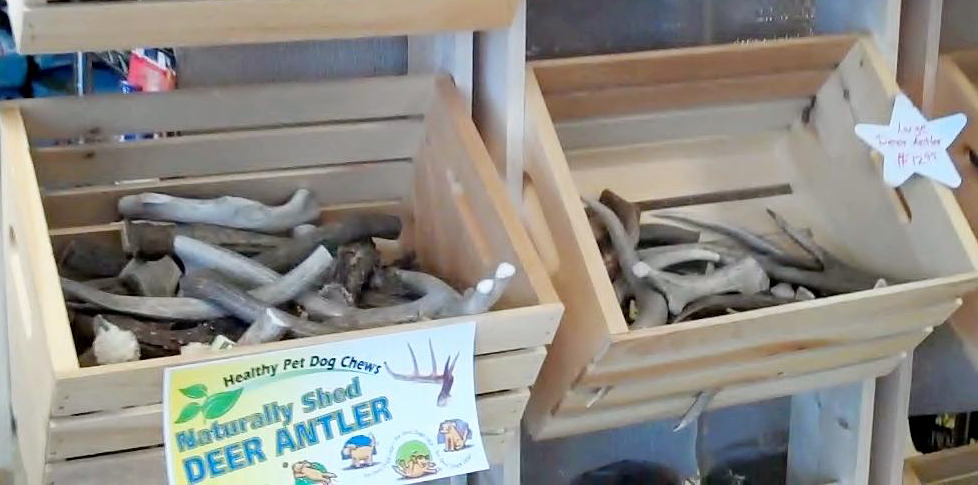
I was determined to stop that this Christmas, especially since I’ve heard of local stores offering antlers as alternatives to bones for dogs with allergies like Sensi.
My original plan was to make the trip down to The Pet Beastro in Madison Heights. I started receiving press releases about this new pet store earlier this year and have been wanting to blog about it.
In one press release, it states the store sells everything from dehydrated bunny ears, beef or lamb tracheas, freeze dried chicken hearts, cheese treats, elk antlers and more eclectic items — many of which Sensi, despite all his allergies, would be able to have.
I mentioned this to my dog-loving aunt, who said: “What about that new store on M-24? I think they sell items like that.”
She piqued my curiosity, so last weekend, I stopped in at Healthy Pet, 1472 S. Lapeer Road in Lake Orion, to check it out and do some Christmas shopping.

Video from my trip to Healthy Pet


Christmas treats at Healthy Pet
Now, I’m happy to tell you that whether you live in the northern reaches of Oakland County, like myself, or in the southern part, you have a choice of stores to shop for healthy products for your dog — even if your dog has allergies. If you live north, check out Healthy Pet (248-690-7796). If you live south, check out The Pet Beastro (248-548-3448).
I was so impressed with the selection of kibble available at Healthy Pet that after I get through one more bag of Sensi’s prescription kibble, I’m going to start buying from Healthy Pet. I haven’t decided on a brand yet, but no matter what I choose, it’s going to be about $45 cheaper than the prescription food (we’re paying $95 for a 30 lb. bag).
Last weekend, I purchased Sensi a medium-sized antler for $12.95. You can pay up $25 for a monster elk antler too.
I also found some jerky sticks on the counter for $1 a piece — chicken and turkey, both safe for Sensi.
There’s a good selection of treats that are organic or natural. You can
Antlers available at Healthy Pet
even get a giant “Merry Christmas” baked cookie for your dog!
Baked Merry Christmas cookies at Healthy Pet
For those interested in raw food diets, there’s a refrigerator with those items too.
I also intend to try some of the supplement powders offered for allergenic dogs.
The owners of Healthy Pet, Mary Beth Darby and her husband Tom Peters, said the store grew out of their rapidly expanding online business, www.K9CriticalCare.com. Darby said the online business focused on foods and health supplements for sick dogs, like those with cancer.
By the way, there’s stuff for cat owners too, and even bird food. Sorry folks, but I didn’t spend a whole lot of time perusing those items.
If you’re thinking about checking it out, you absolutely must go this Saturday, Dec. 18. Healthy Pet is offering 10 percent off everything in their store, giving a free gift with purchases and you can walk a storefront down to get a free slice of Chicago Bros pizza after making your purchase.
And let me tell you something about Chicago Bros pizza — it’s the best, hands down, anywhere around. I will drive 20 minutes out of my way to pick up pizza from Chicago Bros. It’s the dough, in my opinion, that makes it so darn delicious. While you’re there, pick up an order of breadsticks. You’ll be hooked for life.
Dog and cat adoptions will also be available at Healthy Pet on Saturday, Dec. 18.
So if you’re thinking about checking it out, make time to go tomorrow!
Merry Christmas to all you dog owners out there — I hope you find the perfect gift for your pooch, allergies or not!

Thursday, December 16, 2010

So, Michael Vick wants a dog, but should he have one?

There’s lots of opinions on this, and I’m going to post here what people are telling me.
But first, what’s my opinion?
Well, in a non-Michael Vick related post called Dog ownership for dummies I wrote this:
“If your pit bull gets loose and kills a puppy or mauls a person, you should be banned from owning dogs. You had your shot at dog ownership and you did such an incredibly bad job that other people or living beings had to suffer as a result of your stupidity and/or irresponsibility.
“And if you’re caught dragging a dog behind your car, well ... I hope karma gives you back the pain you caused another living being tenfold.”
I think fighting and killing dogs (and yes folks, he was directly involved in this. Don’t believe me? Check out Jim Gorant's book, The Lost Dogs: Michael Vick's dogs and their tale of rescue and redemption and my blog post, New book tells the tale of Michael Vick dogs) falls into that category too.
To recap: If you do something that horrible, you’ve had your shot and you did such an incredibly bad job that other living beings had to suffer as a result.
I think Twitter follower @AndrewPritchard speaks to this when he wrote with sarcasm: “Yes, while we’re at it, let’s allow child molesters to adopt!”
Here’s more of what you had to say about the topic:

From The Oakland Press Facebook fan page:
Bette Boling Haas: No way !!!!
Michelle Bennett: Would be a travesty for the poor dog that gets him for an owner.
Angela Kula Powers: No. Anyone who thinks otherwise should read the book The Lost Dogs: Michael Vick's Dogs and Their Tale of Rescue and Redemption
Eve R. Pickman: Michael Vicks should be rotting in jail, where he can be someone elses b*tch.
Lauren Wells: noooooooooo!
Kevin Sandler: He should be made into dog food.
Kim Davis Eller: No!!! He gave up that right. No Humane Society would even consider him as dog worthy.
Wayne Reif: Why not? Drunk drivers are allowed to own cars.
Mark Steven: Why not? Vic paid his debt to society. Vic's an Eagle and he wants a Beagle!!
JoAnn Browning: absolutely not!
Joe Ogg: First of all mike Vick did rot in jail. And paid his debt to society. If he wants to have a pet he should be aloud to have a pet. I'm sure he is not the same person he was a few years ago. And he knows if he gets a dog all eyes will Be on him. It would go to show that everyone deserves a second chance and that people can change.

From Twitter:
@MsQuote: Sending a dog to Michael Vick would be like sending a kid to Neverland
@ColleenFKelly: NO NO NO! No dogs for M.V! I think it should take more than him “wanting” one, like counseling!! LOTS!
@AndrewPritchard: Yes! While we’re at it, let’s allow child molesters to adopt! sarcasm
@TotallyTypeA: Absolutely NOT!
@helenback54: Never let Michael Vick own a dog. They are not animals to him they are mearly $$ signs. He clearly has no remorse.

What do you think?
Leave me a comment or check out our story online: YOU TELL US: Vick says he hopes to own a dog as a pet someday. Should he be allowed?